BACTERIOLOGICAL EXAMINATION OF WATER

Updated: Apr 16
Definition
Assessment of microbial quality using indicator organisms rather than direct pathogen detection
Why not detect pathogens directly?
Low numbers: Pathogens are often present in very small quantities in samples, making direct detection difficult without prior concentration.
Intermittent presence: Pathogens may not be consistently present in every sample at all times, leading to false-negative results if sampling misses them.
Wide variety: Numerous different pathogens can be present, requiring multiple specific tests rather than a single universal detection method.
Difficult & expensive: Direct detection methods (like molecular assays) require advanced equipment, technical expertise, and high costs, limiting routine use.
👉 Therefore:
✔ Indicator organism concept is used!
Core Principle
👉 “Higher indicator count = higher probability of pathogens”
🦠 INDICATOR ORGANISMS
Definition
Organisms whose presence indicates fecal contamination and possible presence of pathogens
Ideal Criteria (VERY IMPORTANT)
Present in large numbers in feces
Absent in clean water
Survive longer than pathogens
Do not multiply in water
Easy to detect
Constant numbers proportional to contamination
🧬 TYPES OF INDICATOR ORGANISMS
A. COLIFORMS
Definition
Gram-negative, non-spore forming rods
Lactose fermentation → acid + gas (37°C, 48h)
Types
Category | Examples | Significance |
Total coliforms | Mixed group | General contamination |
Faecal coliforms | Thermotolerant | Fecal contamination |
E. coli | Specific | Recent contamination |
Enterococci | Faecal streptococci | Older contamination |
Clostridium | Spores | Remote contamination |
Members
Escherichia coli
Klebsiella
Enterobacter
Citrobacter
Limitations
Some coliforms are environmental
Not always fecal in origin
B. ESCHERICHIA COLI (GOLD STANDARD)
Why best indicator?
Found only in intestine
Does not survive long in water
👉Indicates recent fecal contamination
Lab Features
Lactose fermenter
Indole positive
Growth at 44°C
C. FAECAL STREPTOCOCCI (ENTEROCOCCI)
Features
Gram-positive cocci
Grow in:
6.5% NaCl
45°C
Bile esculin positive
Significance
More resistant than coliforms
Survive longer
👉 Indicates:✔ Older contamination
D. CLOSTRIDIUM PERFRINGENS
Features
Spore-forming anaerobe
Sulphite reducing
Significance
Spores highly resistant
Survive long periods
👉 Indicates:✔ Remote/intermittent contamination
E. OTHER INDICATORS
Indicator | Use |
Pseudomonas aeruginosa | Hospital water contamination |
Bacteriophages | Viral contamination |
Protozoa (Giardia, Cryptosporidium) | Waterborne outbreaks |
INDICATOR HIERARCHY
E. coli → Recent contamination
↓
Enterococci → Older contamination
↓
Clostridium spores → Remote contamination
COLLECTION OF WATER SAMPLE
Principles
Avoid contamination
Neutralize disinfectants
Steps
Sterile bottle + *sodium thiosulfate
Tap:
Run water 2–3 min
River:
Collect upstream
Volume:
≥100 ml
Transport:
Within 6 hours
Keep cool
*Sodium thiosulfate: Added to neutralize residual disinfectants like chlorine in the sample, which would otherwise kill bacteria and give falsely low counts.
METHODS OF WATER ANALYSIS
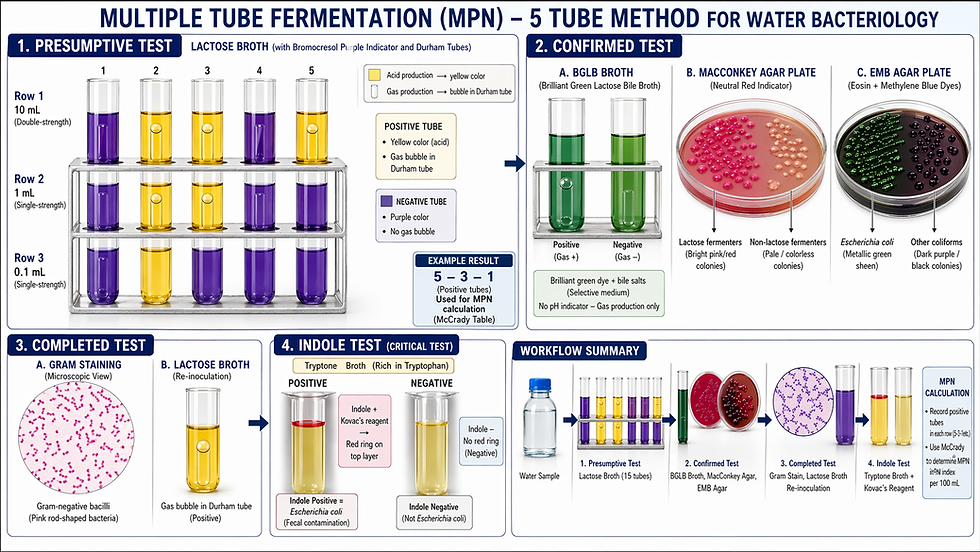
🔬 A. MULTIPLE TUBE METHOD (MPN)
Principle
Serial dilution + lactose fermentation
Steps
1. Presumptive test
MacConkey broth
Acid + gas
2. Confirmed test
Selective media
3. Completed test
Identification
Result
👉 Expressed as MPN / 100 ml
Advantages
Useful for turbid water
Limitations
Statistical estimate
Time-consuming
🔬 B. EIJKMAN TEST
Purpose
Confirm E. coli
Principle
Growth at 44°C
Gas + indole production
Interpretation
Result | Meaning |
Gas at 37°C | Coliform |
Gas + indole at 44°C | E. coli |
🔬 C. MEMBRANE FILTRATION
Principle
Filter known volume
Culture retained bacteria
Steps
Filtration
Culture on selective media
Count colonies
Advantages
Quantitative
Rapid
Most widely used
Limitation
Not suitable for turbid water
🔬 D. PLATE COUNT (HPC)
Measures
Total viable bacteria
Conditions
Temp | Organisms |
22°C | Environmental |
37°C | Fecal origin |
Ideal count
30–300 colonies
Limitation
Not specific
🔬 E. ATP TESTING (MODERN)
Principle
ATP → luciferase → light
Advantage
Rapid
Real-time
Limitation
Non-specific
🔬 F. MOLECULAR METHODS
PCR:
lacZ → coliform
lamB → E. coli
Limitation
Detects dead organisms
🧫 CULTURE MEDIA
Medium | Use |
MacConkey broth | Coliform detection |
Endo agar | Coliform confirmation |
mFC agar | Faecal coliform |
Slanetz & Bartley | Enterococci |
DRCM | Clostridium |
Lauryl sulphate broth | Membrane filtration |
📊 INTERPRETATION OF RESULTS
Core Concept
👉 Interpretation based on indicator organism levels
Table
Finding | Interpretation |
E. coli present | Recent fecal contamination |
High coliforms | Unsafe water |
Enterococci | Older contamination |
Clostridium spores | Remote contamination |
Additional Interpretation
Coliforms in chlorinated water → treatment failure
High plate count → organic pollution
🦠 WATERBORNE PATHOGENS
Bacteria
Salmonella
Shigella
Vibrio cholerae
Viruses
Hepatitis A
Rotavirus
Protozoa
Giardia
Cryptosporidium
👉 Resistant to chlorination
📏 BACTERIOLOGICAL STANDARDS
Drinking Water (WHO concept)
Parameter | Acceptable |
E. coli | 0 / 100 ml |
Total coliform | 0 / 100 ml |
Enterococci | 0 |
Clostridium spores | <5 / 100 ml |
Plate count
Sudden increase → contamination
⚠️ LIMITATIONS OF WATER ANALYSIS
Small sample → error
Indicators ≠ pathogens
Viruses/protozoa missed
Environmental coliforms possible
🧪 SPECIAL METHODS
Moore swab
Sewage sampling
Concentration techniques
Large volume testing
🏊 SWIMMING POOL WATER
Chlorine: 1–2 ppm
If adequate → safe
❓ FAQs
1. Why is E. coli the best indicator of water contamination?
Because it is found only in the intestine and indicates recent fecal contamination.
2. What is the MPN test in water analysis?
It is a statistical method used to estimate coliform count based on lactose fermentation.
3. Which method is most accurate for water testing?
👉 Membrane filtration is considered the modern gold standard.
4. Can chlorine kill all pathogens in water?
No. Protozoa like Cryptosporidium are resistant.
Comments