INDole Test

1. 🔬 INTRODUCTION
The Indole test is a fundamental biochemical assay used to determine the ability of bacteria to degrade Tryptophan metabolism via the enzyme tryptophanase, producing indole, which is detected chemically.
📌 Widely used in:
Identification of Enterobacteriaceae
Differentiation in IMViC reactions
2. 🧬 BIOCHEMICAL BASIS

Interpretation
Tryptophanase enzyme cleaves tryptophan
Produces:
Indole → diagnostic marker
Pyruvate → enters metabolism
Ammonia → nitrogen metabolism
WHY this reaction occurs?
Tryptophan serves as:
Carbon source
Nitrogen source
Organisms with tryptophanase gain metabolic advantage in protein-rich environments
3. 🧪 CHEMICAL DETECTION PRINCIPLE
Reaction with Kovac’s / Ehrlich’s reagent

WHY red color forms?
Indole nucleus reacts with aldehyde group (DMAB)
Produces rosindole dye
Visible as pink/red layer
4. 🧴 REAGENTS (WITH MECHANISTIC INSIGHT)
A. Kovac’s Reagent
Composition
p-dimethylaminobenzaldehyde (DMAB)
Isoamyl alcohol
Concentrated HCl
Functional roles
Component | Role | WHY |
DMAB | Reacts with indole | Forms colored complex |
HCl | Acidifies medium | Required for condensation reaction |
Isoamyl alcohol | Organic solvent | Extracts indole to surface |
👉 Key concept:Indole is lipophilic → concentrates in alcohol layer → sharp red ring
B. Ehrlich’s Reagent
Composition
DMAB + Ethanol + HCl
WHY more sensitive?
Better solubility
Detects low indole producers
5. 🧫 MEDIA
Tryptophan-rich media
Types
Tryptone broth
Peptone water
SIM medium
MIO medium
WHY tryptophan-rich medium?
Indole production depends on substrate availability
Low tryptophan → false negative
6. ⚙️ PROCEDURE (STANDARDIZED)
Conventional Method
Inoculate medium
Incubate at 37°C for 24–48 hrs
Add Kovac’s reagent
Observe surface layer
WHY each step matters?
Step | Reason |
Incubation | Allows enzyme synthesis |
Time control | Prevents false reactions |
Reagent addition | Detects indole |
No mixing | Maintains interface |
7. 🎯 INTERPRETATION
Positive Test
Red / pink ring at top
Indicates presence of tryptophanase
Negative Test
No color change
Yellow or unchanged layer
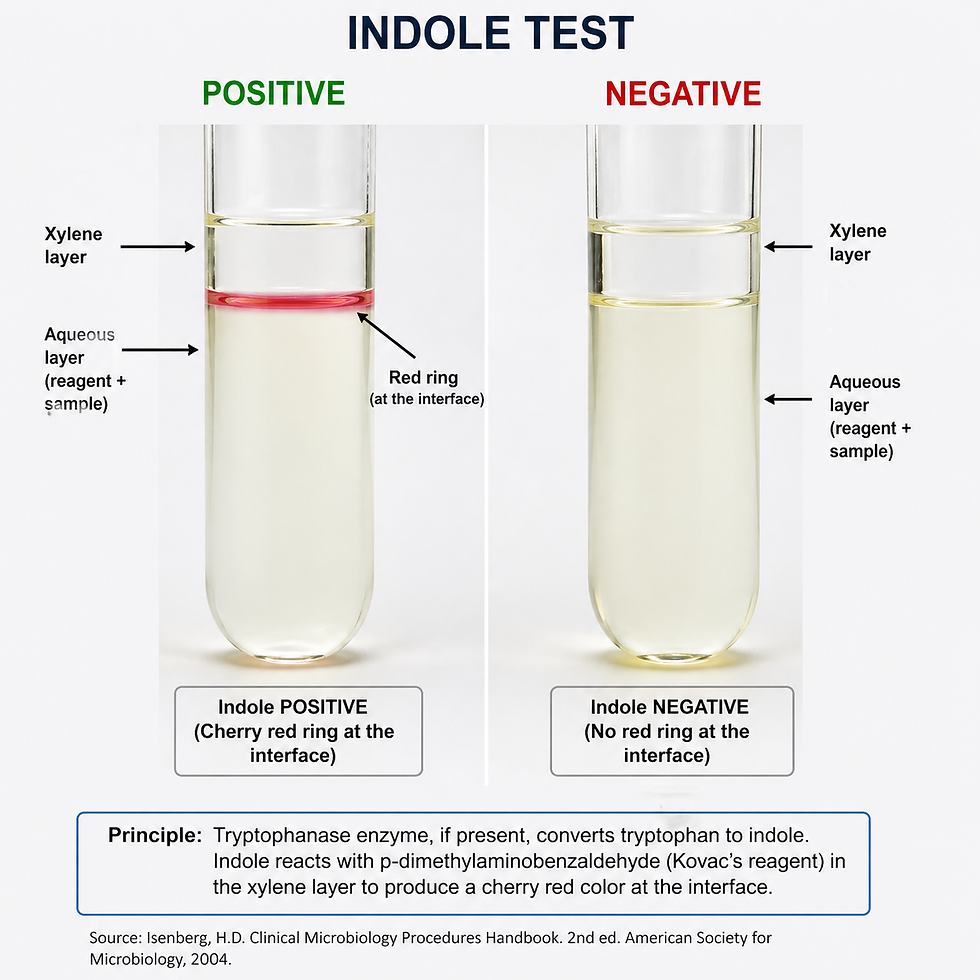
WHY color at surface?
Organic layer floats above aqueous medium
Reaction occurs at interface
8. 🧠 EXTRACTION PRINCIPLE (ADVANCED)
WHY extraction step is needed (Ehrlich method)?
Indole:
Poorly soluble in water
Highly soluble in organic solvents
👉 Xylene/chloroform used:
Concentrates indole
Enhances sensitivity
9. ⚠️ LIMITATIONS & ERRORS
False Positives
Prolonged incubation → breakdown products react
False Negatives
Weak enzyme producers
Inadequate tryptophan
Technical Issues
Old cultures
Improper reagent storage
10. 🧪 QUALITY CONTROL
Control | Organism |
Positive | Escherichia coli |
Negative | Klebsiella pneumoniae |
11. ⚡ RAPID / SPOT INDOLE TEST
Principle
Direct colony + reagent on filter paper
Advantage
Rapid detection (seconds)
Limitation
Less sensitive than broth method
12. 🧬 CLINICAL & TAXONOMIC IMPORTANCE
Key differentiations
Organism | Indole |
E. coli | + |
Klebsiella | – |
Proteus vulgaris | + |
Proteus mirabilis | – |
Role in IMViC
I → Indole
M → Methyl Red
V → Voges-Proskauer
C → Citrate
13. 🔬 ADVANCED INSIGHTS (PhD LEVEL)
1. Indole as signaling molecule
Regulates:
Biofilm formation
Virulence
Antibiotic resistance
2. Atypical reactions
Orange indole reaction
Due to anthranilic acid
Seen in some non-enteric bacteria
3. Molecular basis
Encoded by tnaA gene
Regulated by:
Tryptophan availability
Environmental stress
14. 🧾 CONCLUSION
The Indole test is a simple yet powerful biochemical tool that integrates:
Enzymology (tryptophanase)
Organic chemistry (aldehyde reaction)
Diagnostic microbiology (organism differentiation)
Its continued relevance lies in:
Routine lab identification
Teaching metabolic diversity
Understanding microbial signaling
15. 📚 REFERENCES
Bailey & Scott's Diagnostic Microbiology
Koneman’s Color Atlas and Textbook of Diagnostic Microbiology
Biochemical Tests for Identification of Medical Bacteria


Comments