Vibrio

🦠 1. Morphology & Ultrastructure

Cell Shape & Arrangement
Curved rods (“comma-shaped”) due to asymmetric cell wall growth
Can appear:
Single curved rods
Paired → “S-shaped” or gull-wing appearance
Pleomorphism may occur in old cultures
Cell Wall
Typical Gram-negative structure
Thin peptidoglycan
Outer membrane with LPS (endotoxin activity)
Lipid A → contributes to inflammatory response
Flagella
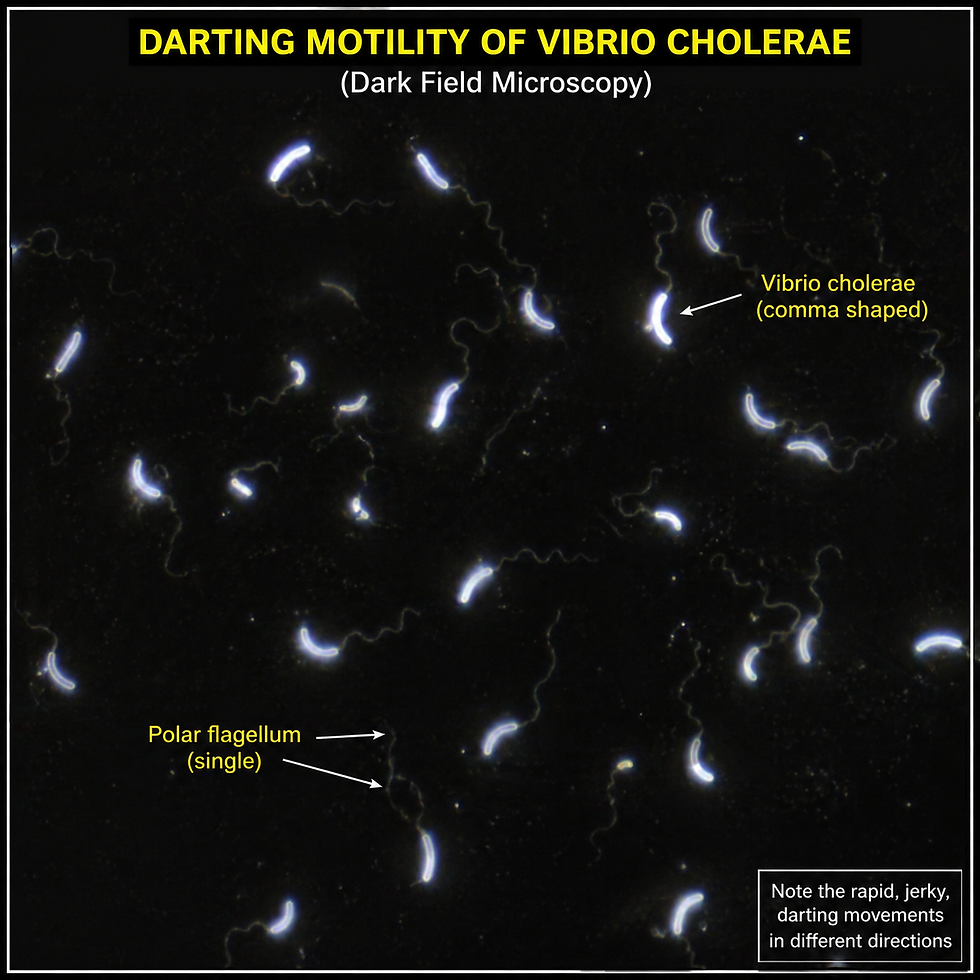
Monotrichous polar flagellum
Surrounded by sheath (extension of outer membrane) → unique feature
Enables:
Rapid motility
Chemotaxis in intestinal mucus
👉 Clinical relevance: explains darting motility in hanging drop
Capsule
Generally absent in Vibrio cholerae
Prominent in Vibrio vulnificus → virulence factor
🧫 2. Cultural Characteristics & Growth Physiology
🧪 1. Growth Requirements
Temperature
Optimum: 35–37°C (human pathogens)
Environmental strains: grow at 20–30°C
Some vibrios survive at low temperatures → persistence in water
👉 Reason: Enzymatic systems adapted for both host + aquatic environments
pH Requirement (Key Diagnostic Feature)
Optimum pH: 8.2–9.5 (alkaline)
Poor survival in acidic pH
👉 Why alkaline preference?
Vibrio membrane transport systems function better at alkaline pH
Competing gut flora suppressed at high pH → selective advantage
👉 Clinical relevance:
Acid-sensitive → requires high infective dose
Antacids ↑ susceptibility to cholera
Oxygen Requirement
Facultative anaerobes
Prefer aerobic conditions
Can grow anaerobically via fermentation
👉 Energy metabolism:
Oxidative metabolism (ETC active → oxidase positive)
Can switch to fermentative pathways
Salt Requirement (Halophilism)
Type | Example | NaCl Requirement |
Non-halophilic | Vibrio cholerae | No NaCl required |
Halophilic | Vibrio parahaemolyticus | Requires 1–3% NaCl |
Highly halophilic | Some marine vibrios | Up to 6–8% |
👉 Mechanism:
Sodium gradient drives:
Flagellar motion
Nutrient transport
👉 Exam point:
Growth failure in NaCl-free media → suggests marine Vibrio
🧫 2. Growth in Liquid Media
Nutrient Broth
Uniform turbidity
Surface pellicle may form
👉 Pellicle formation reason:
Oxygen-seeking behavior (aerophilic tendency)
Alkaline Peptone Water (APW)
pH: ~8.5–8.6
Composition:
Peptone (nutrients)
Sodium chloride
Alkaline buffer
Role
Selective enrichment medium
Enhances Vibrio growth within 6–8 hours
👉 Mechanism of selectivity:
Alkaline pH inhibits:
Enterobacteriaceae
Gram-positive flora
👉 Important point:
Subculture must be done early (6–8 hrs)
→ Overgrowth of contaminants later
🧫 3. Growth on Solid Media
A. Nutrient Agar
Colonies:
Smooth
Round
Translucent
Moist, glistening
👉 No distinctive pigmentation
B. Blood Agar
Colonies similar to nutrient agar
Hemolysis:
Usually absent in Vibrio cholerae
Present in:
Vibrio parahaemolyticus
Vibrio vulnificus
C. MacConkey Agar
Non-lactose fermenting colonies (pale)
Growth may be poor for some vibrios
👉 Reason:
Bile salts inhibit certain Vibrio strains
D. TCBS Agar (Most Important)

Composition & Function
TCBS is the selective medium of choice, but not the only medium
Component | Role |
Thiosulfate | H₂S detection |
Citrate | Alkalinity |
Bile salts | Inhibit Gram positives |
Sucrose | Differentiation |
Bromothymol blue | Indicator |
Colony Differentiation
Species | Colony Color | Reason |
Vibrio cholerae | Yellow | Sucrose fermentation → acid |
Vibrio parahaemolyticus | Green | No sucrose fermentation |
👉 Key concept:
Acid production → indicator turns yellow
⚙️ 4. Growth Kinetics & Environmental Adaptation
Growth Curve
Typical bacterial phases:
Lag
Log
Stationary
Decline
👉 Vibrio shows:
Rapid log phase in alkaline environment
Biofilm Formation
Occurs in aquatic environments
Adheres to:
Plankton
Shellfish
👉 Importance:
Environmental persistence
Increased infectivity
VBNC State (Viable But Non-Culturable)
Under stress:
Low temperature
Nutrient depletion
👉 Cells:
Alive but not culturable
Can revert to active state
👉 Public health significance:
Hidden reservoirs → outbreaks
🌊 5. Marine Ecology & Growth Adaptation
Natural Habitat
Estuarine & marine waters
Associated with:
Zooplankton
Chitin surfaces
Environmental Factors Affecting Growth
Factor | Effect |
Temperature ↑ | Increased Vibrio counts |
Salinity | Species-specific requirement |
Organic matter | Promotes growth |
🔬 6. Special Physiological Traits
Sodium-dependent metabolism
Unique among bacteria
Na⁺ gradient used for:
Motility
Transport
Oxidative metabolism
Presence of:
Cytochrome oxidase
Explains oxidase positivity
Rapid multiplication
Doubling time ~20–30 minutes under optimal conditions
⚗️ 3. Biochemical Reactions
Test | Result | Mechanism |
Oxidase | + | Cytochrome c oxidase present |
Indole | + | Tryptophan → indole via tryptophanase |
Nitrate | + | NO₃⁻ → NO₂⁻ reduction |
Urease | – | Lacks urease enzyme |
String test | + | Cell wall lysis → DNA release |
String Test
Reagent: 0.5% Sodium deoxycholate
Mechanism:
Detergent lyses cell → releases DNA
DNA forms viscous “string”
👉 Diagnostic for vibrios vs Enterobacteriaceae
Vibrios are sensitive to O/129 (2,4-diamino-6,7-diisopropylpteridine), helping differentiate them from Aeromonas.
🧬 4. Antigenic Structure & Classification
O Antigen (LPS)
Basis of serogrouping
Key Serogroups:
O1 → epidemic cholera
O139 → Bengal strain
O1 Subclassification
Serotypes:
Ogawa
Inaba
Hikojima
Biotypes
Feature | Classical | El Tor |
Hemolysis | – | + |
VP test | – | + |
Polymyxin B | Sensitive | Resistant |
👉 Exam point: El Tor causes current pandemics
🧬 5. Virulence Factors (Molecular Level)
Cholera Toxin (CTX)
AB5 toxin
A subunit → enzymatic
B subunit → binding
Mechanism
ADP-ribosylates Gs protein
Locks adenylate cyclase → ↑ cAMP
Opens CFTR channels → Cl⁻ secretion
👉 Water follows → profuse diarrhea
Other Virulence Factors
TCP (Toxin Coregulated Pilus)
Colonization factor
Also receptor for CTX phage
Hemolysin (TDH)
Seen in Vibrio parahaemolyticus
Causes Kanagawa phenomenon
Capsule
Vibrio vulnificus
→ prevents phagocytosis
🧫 6. Pathogenesis
Stepwise Pathogenesis
Ingestion via contaminated water
Survives gastric acid (large inoculum needed)
Colonizes small intestine (jejunum/ileum)
Produces CTX toxin
Causes secretory diarrhea WITHOUT invasion
👉 Key concept: Non-inflammatory diarrhea

🧍 7. Clinical Spectrum
Cholera
Incubation: 1–2 days
Symptoms:
Rice-water stool
Severe dehydration
Sunken eyes, hypotension
👉 Death due to hypovolemic shock
V. parahaemolyticus
Seafood-associated
Incubation: 6–24 hrs
Features:
Diarrhea
Abdominal cramps
Sometimes dysentery-like
V. vulnificus
High mortality (~50%)
Risk group:
Liver disease
Alcoholics
Causes:
Septicemia
Necrotizing fasciitis
🧪 8. Laboratory Diagnosis
Specimen
Stool (acute stage)
Rectal swab
Workflow
Microscopy
Darting motility
Gram-negative curved rods
Dark-field microscopy is suggestive but not confirmatory; culture remains the gold standard.
Enrichment
APW (6–8 hrs)
Culture
TCBS agar
Transport medium
Cary-Blair medium
Biochemical tests
Oxidase +
String test +
Serotyping
O1 / O139 antisera
Molecular
PCR (ctx gene detection)
💊 9. Treatment
Rehydration Therapy
ORS works via:
Na⁺-glucose cotransport intact
Even in cholera → absorption preserved
Antibiotics
Doxycycline
Azithromycin
👉 Reduce duration & shedding
🌍 10. Epidemiology & Ecology
Associated with:
Plankton
Shellfish
Pandemics
7th pandemic → El Tor biotype
Environmental Survival
VBNC state (Viable but Non-Culturable)
Biofilm formation → persistence
🧠 11. Advanced Thesis Concepts
Phage Conversion
CTX gene via bacteriophage
👉 Example of lysogenic conversion
Quorum Sensing
Regulates virulence gene expression
Climate Link
Rising sea temperature → increased Vibrio outbreaks
📌 Final High-Yield Integration
Oxidase +, curved rods, darting motility
Alkaline growth → key diagnostic clue
Cholera = toxin-mediated, non-invasive diarrhea
TCBS differentiation → sucrose fermentation
Halophilic vs non-halophilic differentiation


Comments